

Standards Are Usually Quiet
EVIDENCE OF STANDARDS
· No. 11 · Published June 11, 2026
Most people never notice good construction.
They notice the stone, the cabinetry, the light, the architecture. They notice proportion, warmth, and atmosphere. They rarely stop to consider why a room feels composed rather than merely expensive.
That is because the best standards are almost invisible.
When construction is executed with discipline, there is nothing demanding attention. Materials meet cleanly. Lines remain uninterrupted. Transitions feel inevitable. Every trade has made hundreds of small decisions that disappear into the finished work.
Poor construction announces itself. Good construction disappears.

This is one of the quiet paradoxes of residential building. The more carefully a project is executed, the less obvious the execution becomes. Visitors walk through the home believing everything simply “fits,” without realizing that dozens of consultants, trades, and craftspeople spent months protecting those relationships.
These moments are rarely defined by complexity. They are defined by consistency.
A cabinet reveal that remains perfectly even across an entire elevation.
A stone countertop that terminates exactly where the architecture intended.
A flooring transition that disappears instead of interrupting movement through the space.
Individually, these details seem insignificant. Collectively, they establish the character of the project.
This is why construction standards cannot be created on the jobsite. They must exist long before anyone begins building. They live inside drawings, specifications, coordination meetings, mockups, shop drawings, and conversations that most clients never see.
The work that protects architecture almost always happens before architecture is visible.
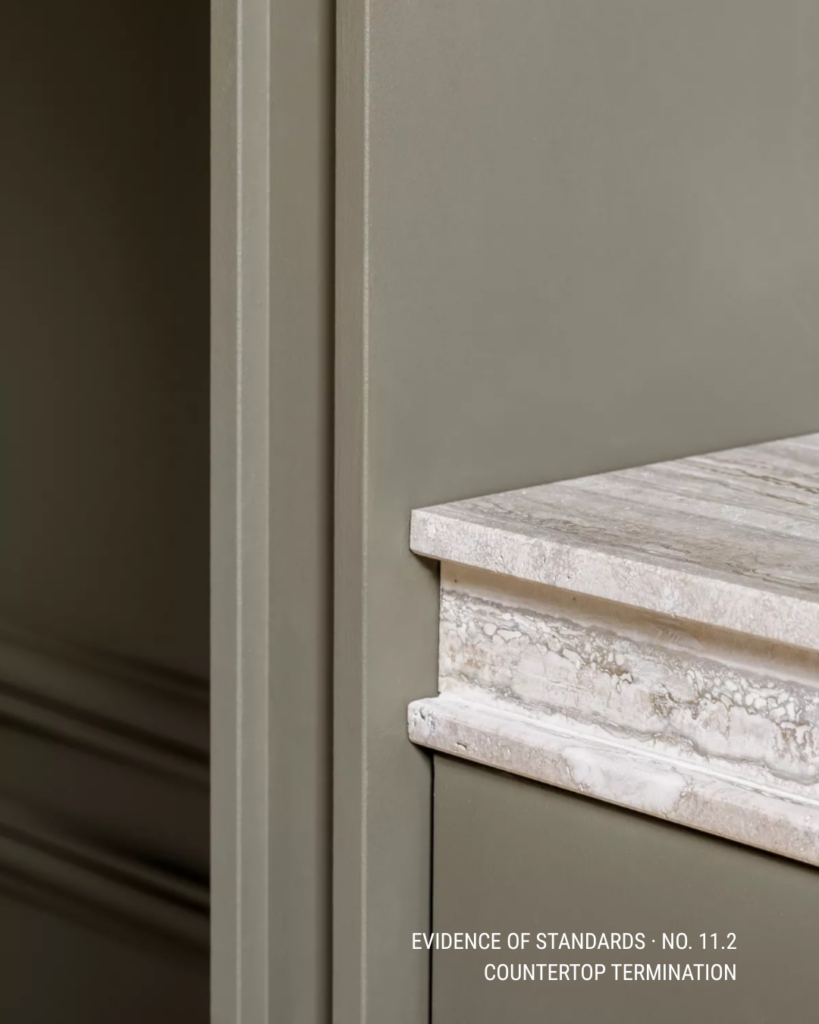

For us, standards are not about perfection for its own sake. They are about preserving the intent behind someone else’s design. Every architect has already answered hundreds of important questions before construction begins. Our responsibility is not to reinterpret those decisions, but to execute them with enough discipline that the original idea remains intact.
The success of a finished home is rarely determined by one extraordinary detail. More often, it is determined by hundreds of ordinary decisions made consistently.
The success of a finished home is rarely determined by one extraordinary detail. More often, it is determined by hundreds of ordinary decisions made consistently.
That consistency is what gives a project its sense of calm.
It is why some homes feel effortless while others, even with larger budgets or more expensive materials, never quite settle.
People often describe these projects as timeless.
We think they are simply well protected.
CONTINUE THE CONVERSATION
Continue exploring What Great Builders Do Differently
Continue exploring Evidence of Standards
Continue exploring Dissect the Specs