
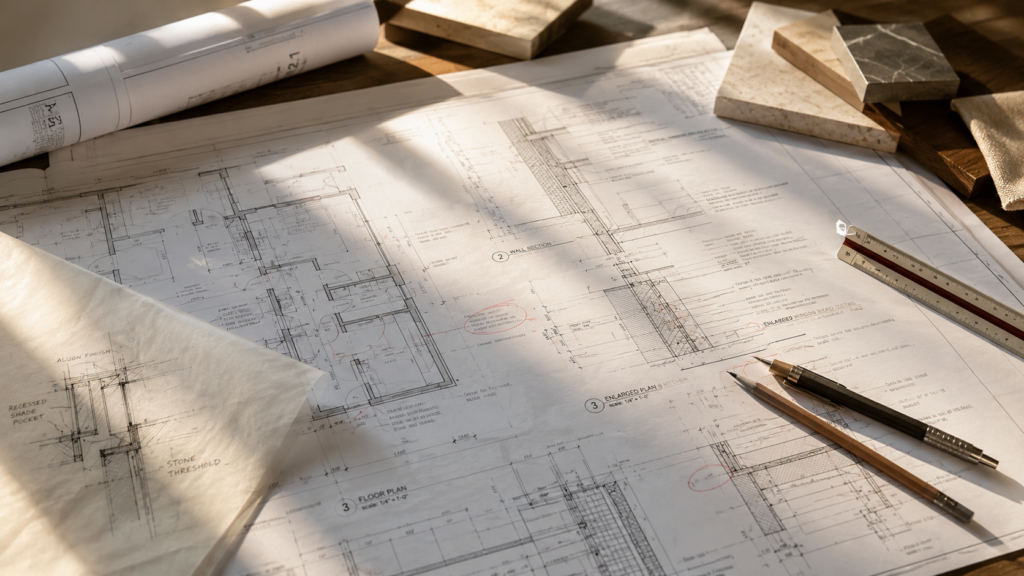
Understanding Permits & Approvals
WHY CONSTRUCTION HASN’T STARTED YET
Most homeowners imagine permitting as paperwork
In reality, permit approval is a coordinated review process that determines whether a project is ready to move from ideas and drawings into construction.
Before a permit is issued, a project may be reviewed by architects, engineers, planning officials, building officials, energy consultants, fire agencies, environmental departments, and utility providers. Each review exists to answer a different question about the project’s safety, compliance, and long-term performance.
The approval process can feel slow from the outside. In practice, it is often where many of the most important decisions are tested before construction begins.
Projects that move through approvals successfully are rarely the simplest. They are usually the most thoroughly prepared.
WHY PERMITS EXIST
Permits are often viewed as a bureaucratic requirement.
They are better understood as a risk management system. Every review is intended to protect something:
- The safety of the occupants
- The integrity of the structure
- The surrounding community
- Public infrastructure
- Environmental resources
- Long-term building performance
The goal is not simply to obtain a permit. The goal is to ensure that the project is ready to be built.
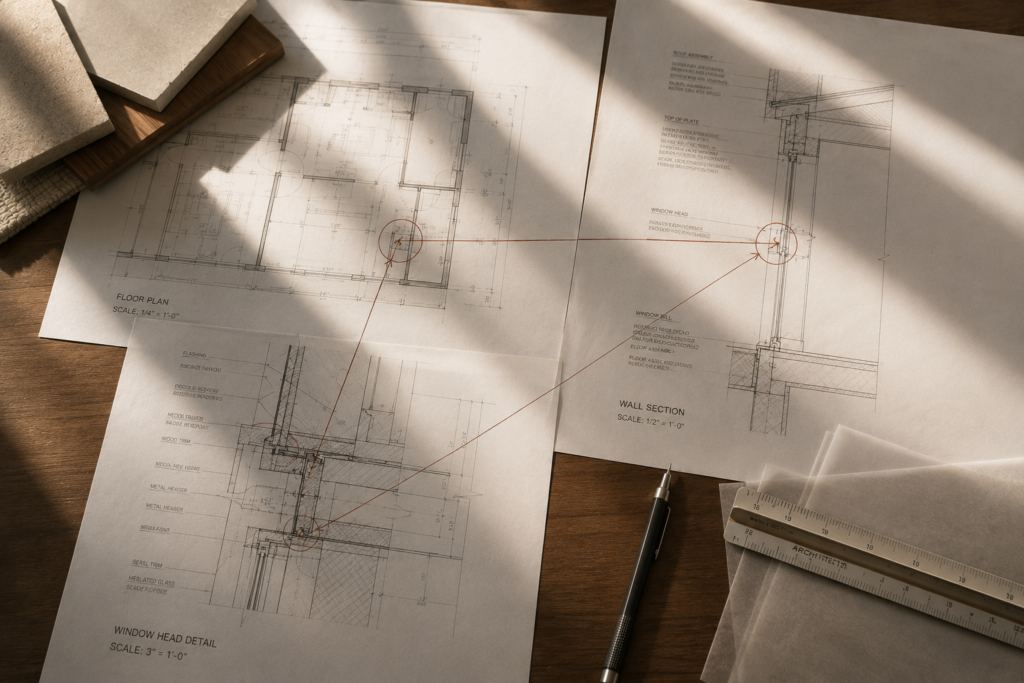
WHO REVIEWS YOUR PROJECT?
Many homeowners are surprised by the number of professionals involved before construction begins.
01 | Planning Department
The Planning Department evaluates whether the project complies with local zoning requirements, setbacks, design standards, site constraints, and community regulations.
The question being answered is: “Is this project appropriate for this property?”
02 | Building Department
The Building Department reviews the project for code compliance and life safety requirements.
The question being answered is: “Can this project be built safely?”
03 | Structural Engineering
Structural engineers review and design the systems that support the building. They evaluate foundations, framing, lateral resistance, and structural connections.
The question being answered is: “Will this structure perform as intended?”
04 | Energy Compliance
California projects must comply with increasingly complex energy standards. Energy consultants verify that insulation, glazing, mechanical systems, and other components meet current requirements.
The question being answered is: “Does the project satisfy California energy regulations?”
05 | Fire Department Review
Fire review may evaluate emergency vehicle access, water supply requirements, fire flow calculations, address visibility, residential fire sprinkler systems, and other life-safety considerations.
The question being answered is: “Can emergency responders safely access and protect this property?”
06 | Wildland Urban Interface (WUI)
Many Sonoma County properties fall within wildfire-prone areas. Projects may be subject to additional requirements for materials, assemblies, defensible space, and fire-resistant construction.
The question being answered is: “Can the project better withstand predictable wildfire risks?”
07 | Septic and Environmental Review
Properties without municipal sewer service often require septic review and approval. Site conditions, soils, drainage, and environmental constraints may also require additional evaluation.
The question being answered is: “Can the property safely support the proposed improvements?”
The Typical Approval Process
While every project is different, most follow a similar path.
1. Project Development
Goals, priorities, budget, and project scope are established. Major decisions are identified early.
2. Design & Documentation
The architect and consultants develop the drawings and technical information required for review.
3. Permit Submission
The completed package is submitted to the appropriate agencies.
4. Agency Review
Reviewers evaluate the project and issue comments, questions, or correction requests.
5. Responses & Revisions
The design team responds to comments and updates the drawings as necessary.
6. Permit Approval
Once all required approvals are obtained, the permit is issued and construction may begin.
Why Permits Take Longer Than Expected
Permit timelines are often influenced by factors that have little to do with the actual size of the project.
Common causes of delay include:
Incomplete Decisions
Unresolved design questions frequently create additional review cycles.
Missing Information
Permit reviewers can only evaluate what has been submitted.
Existing Site Conditions
Unexpected conditions often require additional investigation or documentation.
Late Design Changes
Changes made during review can restart portions of the approval process.
Agency Review Schedules
Most departments operate on fixed review cycles and workloads that are outside the project team’s control.
WHAT HOMEOWNERS CAN DO TO HELP
The most successful projects typically share a few characteristics:
- Clear goals
- Defined priorities
- Timely decisions
- Realistic expectations
- A coordinated project team
Permit approval is often less about speed and more about preparation.
The projects that move through review most efficiently are usually the ones that enter the process with the fewest unanswered questions.
HOW PRECONSTRUCTION SHAPES COST AND TIMELINE
A well-executed preconstruction phase leads to more predictable cost, a more reliable timeline, and a more controlled construction process.
Cost and timeline are largely determined during preconstruction.
Early decisions about scope, structure, and materials directly influence both overall investment and project duration.
Reviewing cost and timeline early provides the clearest understanding of what a project requires.
What This Means For Homeowners
Permit approval is not a hurdle standing between you and construction.
It is one of the most important forms of project coordination that occurs before anyone arrives on site.
Many of the problems that cause delays, budget increases, or construction challenges are discovered during planning, engineering, and permit review. While those discoveries can feel frustrating in the moment, they are almost always less expensive and less disruptive than discovering the same issues during construction.
The goal is not simply to get approved.
The goal is to arrive at construction with greater clarity, fewer surprises, and a project that is ready to move forward with confidence.

Exceptional projects rarely begin with construction. They begin with clarity. Let’s determine whether Project Development is the right next step.